

Introduction
Most retail investors in Kenya buy into equity funds for the wrong reason: they see a high historical return on a marketing flyer and want a piece of the action.
Then, the market dips, their portfolio turns red, and they panic-withdraw at a loss.
This article is designed to talk you out of investing in an equity fund.
It strips away the financial jargon to give you a brutal, practical framework. We have divided the criteria into Hard Disqualifiers (if you fail one, stop immediately) and Behavioral Risk Flags (where you must proceed with extreme caution).
Pre-requisite Reading
This article assumes you already know what an equity fund is, and how it operates. If not, first read ourBeginner’s Guide to Equity Funds in Kenya
The Trade-Off
An equity fund pools money to buy shares of companies on the Nairobi Securities Exchange (NSE).
The core trade-off is that equity funds trade high uncertainty and extreme price volatility for the possibility of higher long-term returns.
The reality is that your principal is completely unprotected. Your balance will fluctuate daily. You will experience multi-year periods where your investment is worth less than what you put in.
The “Hard Rules”
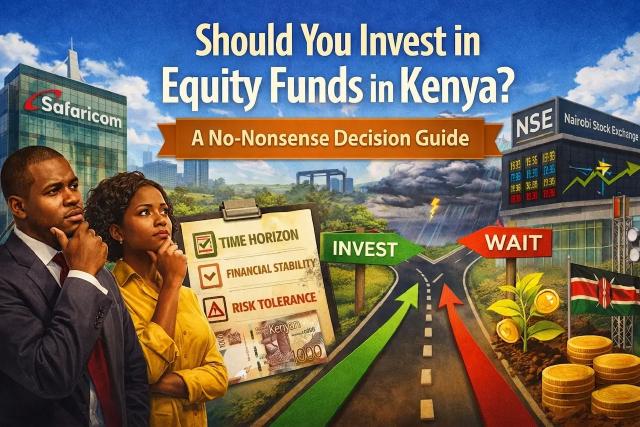
You belong in a Kenyan equity fund only if you meet all three of the following financial conditions. If you fail even one, this product will hurt you.
I. You have a strict 7- to 10-year time horizon
Five years is not enough. The NSE moves in long, drawn-out cycles. Bear markets in Kenya have historically lasted three to four years before a recovery materializes. If you need this money in less than seven years, you are not investing; you are gambling on market timing.
Furthermore, this must be capital you are absolutely certain you will not need for any planned near-term expenses (like buying land, paying school fees, or starting a business) within that window.
A 10-year horizon increases your mathematical probability of recovery, but it does not eliminate the risk of prolonged underperformance.
II. Your financial foundation is already stable
You cannot invest in equities if you are living paycheck to paycheck. Before buying into an equity fund, you must have:
- A predictable income that is not dependent on highly fragile, short-term contracts.
- A fully funded emergency cash buffer (strictly 3 to 6 months of living expenses safely parked in a liquid Money Market Fund).
If you do not have an emergency fund, a sudden medical bill or job loss will force you to withdraw your equity investment at the exact worst time, locking in a permanent loss.
III. Your future liabilities are in Kenya Shillings (KES)
Kenyan equity funds buy local assets. By investing in one, you are concentrating your income, your assets, and your investment risk in a single developing economy.
Local inflation and the shilling’s depreciation will drag on your real purchasing power compared to global assets. Therefore, local equities are suitable primarily for matching local liabilities - like building a home in Kenya or funding a KES-based retirement. If your ultimate goal is to pay for a child’s university education in the UK or retire in the US, local equities expose you to severe currency devaluation risk.
The “Pain Test”
If you passed the three hard rules above, you are financially cleared to invest. But you must now pass the psychological test.
Can you tolerate a 30%+ drop that lasts for years?
Do not ask yourself, “Am I prepared to lose money?” Everyone says yes until it happens.
Kenyan equities routinely suffer massive drawdowns. Ask yourself: “Can I watch my KSh 100,000 drop to KSh 65,000, and remain below my entry point for three straight years, without panic-selling?”
If you have never held an investment through a crash before, you are untested. Stated tolerance is rarely the same as actual tolerance. If your instinct during a market crash is to sell to “stop the bleeding,” an equity fund will systematically destroy your wealth.
Behavioral Disqualifiers
Even if you have the time horizon and the cash, the following specific behaviors make an equity fund fundamentally incompatible with your needs. Do not invest if:
- You are chasing recent returns: If you are only interested because you saw a fund post a “25% return last year,” you are suffering from recency bias. Last year’s winners are often next year’s losers.
- You need predictable income: Equity funds do not pay your monthly bills. Any dividends the underlying companies pay are typically reinvested by the fund manager. Retirees looking for cash flow to replace a salary belong in bonds, not equities.
- You frequently switch investments: If you move money from one fund to another every few months looking for the best yield, the entry fees and market volatility of equity funds will bleed your capital dry.
- You prioritize capital preservation: If your absolute highest priority is never losing a single shilling of your principal, stay out of the stock market entirely.
Your Next Step
Look at the criteria above. Be honest with yourself about where you stand.
Outcome 1
If you failed ANY of the Hard Rules or Behavioral Disqualifiers, stop.
There is no “maybe.” You are in the wrong asset class.
- For short-term cash needs or an emergency fund, use a Money Market Fund (MMF). It protects your principal and provides daily liquidity.
- For predictable, long-term income, look into Treasury Bonds. They lock in a fixed yield over a set duration without daily price panic.
Outcome 2
If your finances are in order, but you have never lived through a 30% multi-year market crash, limit your initial exposure to strictly ≤10% of your investable cash.
This is not portfolio construction; it is a behavioral stress test to see if you panic during the next market dip before committing the core of your long-term wealth.
Outcome 3
You have the right time horizon, the financial stability, the KES-aligned goals, and the psychological temperament to handle the stock market.
Your next hurdle is execution. Buying the wrong fund will subject you to high fees and incompetent management. Move to our next guide: [How to Evaluate Equity Funds in Kenya: A No-Nonsense Screening Checklist], where we break down the exact metrics you must check before giving a manager your money.