

Introduction
If you are a freelancer, an independent contractor, or running a business, traditional financial advice (like the 50/30/20 rule) often feels completely disconnected from your reality. That’s because it was engineered for salaried employees who know exactly what they are getting on the 25th of every month.
When your income arrives in unpredictable bursts, attempting to force a standard monthly budget is highly inefficient and prone to failure.
The mechanism working against you is a specific combination of factors:
Variable Income + Fixed Obligations + A Timing Mismatch = A Cycle of Financial Stress.
Here is why the traditional system breaks down, and the exact method you need to replace it.
The Escalating Danger of the “Good Month”
When your income fluctuates but your bills (rent, tokens, Wi-Fi) have strict deadlines, budgeting is no longer just about tracking expenses; it’s about managing cash-flow timing.
Without a system designed for irregularity, you risk falling into a compounding cycle:
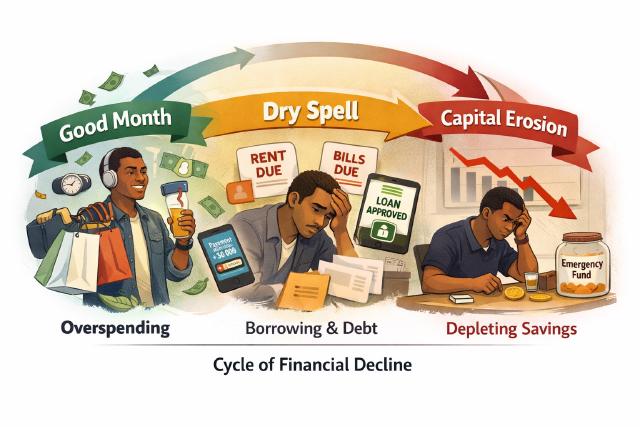
- The “Good Month” Illusion: You land a big gig or have a highly profitable week. Because you don’t have a system to capture and buffer the surplus, your daily spending naturally rises to match your temporary wealth.
- The Dry Spell Deficit: When the inevitable slow week hits, the surplus is already gone. Your fixed obligations are still due, creating a timing mismatch. You are forced to borrow from Fuliza, Tala, or friends just to bridge the gap.
- The Capital Erosion: This is the most dangerous phase. Over time, to pay off the debt accrued during dry spells, business owners begin eating into their operating capital. The volatility hasn’t just caused a bad month; it is systematically eroding your ability to generate future income.
3 Structural Reasons Traditional Budgeting Fails You
1. The Planning Horizon Mismatch Traditional budgets ask you to project your income and plan your spending for a 30-day window. This assumes you hold all the required cash on Day 1. When your income is variable, forecasting a month in advance leads to massive calculation errors. You end up planning for money that hasn’t arrived, creating painful bottlenecks halfway through the month.
2. The Co-mingling of Funds Obscures Reality If you are paid via M-Pesa, your transaction history is a chaotic mix of client payments, personal lunch expenses, and supplier costs. Because business and personal funds share the same ecosystem, you lose clear visibility into your true profit margin versus your personal burn rate.
3. High-Frequency Friction For salaried earners, expenses are often batched. For gig workers and traders, income and expenses happen in dozens of micro-transactions daily—Ksh 150 here, Ksh 800 there. Traditional budgeting requires manual entry. The sheer friction of tracking high-frequency, variable transactions makes it difficult to maintain the habit.
How to Fix It: Timing-Aligned ZBB
To survive income volatility, you must abandon the monthly budgeting horizon. You cannot budget time; you can only budget cash-in-hand.
This requires Zero-Based Budgeting (ZBB).
Traditional budgeting asks: “What will I spend this month?” ZBB asks: “What does this specific money need to do before I get paid again?”
Why this works under volatility: ZBB converts uncertainty into discrete, closed-system decisions. Instead of relying on future income assumptions, every inflow is treated independently. You only make decisions about the money you actually possess, completely neutralizing the risk of a sudden dry spell.
When Ksh 10,000 hits your M-Pesa, you immediately assign every single shilling a job, reducing the unallocated balance to zero:
- Ksh 4,000 to the fixed bill buffer (Rent)
- Ksh 2,000 to business stock replenishment
- Ksh 3,000 to survival expenses (Food/Transport)
- Ksh 1,000 to the volatility buffer (Savings)
By assigning the money the moment it arrives, the surplus is immediately trapped in a buffer, preventing you from accidentally spending next week’s rent on today’s lifestyle.
The Execution Gap: Why Manual ZBB Fails
While ZBB is structurally designed for irregular income, it has a significant operational flaw: frequency of recalculation.
If you get paid four times a day via M-Pesa, manual ZBB requires you to recalculate your allocations four times a day. The friction of constant data entry leads directly to system abandonment. We looked at the best budgeting apps in Kenya and found that most are built around monthly salary templates, lacking the real-time flexibility irregular earners need.
You don’t just need a new budgeting method; you need automation.
That is why we built Kiihela. It doesn’t ask you for a predictable monthly salary. Instead, it acts as an automated M-Pesa Ledger that executes ZBB for you in real-time.
Here is how it works in practice:
- A client sends Ksh 5,000 to your M-Pesa.
- Kiihela instantly reads the inflow and auto-tags the transaction.
- It separates your business revenue from your personal funds.
- It prompts you to instantly route the funds into your custom limits (e.g., “Rent Buffer” or “Restock Fund”).
No manual entry. No end-of-week spreadsheet catch-up. It handles the friction of micro-transactions so you can focus on making money, completely removing the timing mismatch from your cash flow.
Stop letting income volatility dictate your financial stress. You need a system that adapts to your actual reality.