

Introduction
We all know the pattern. You sit down at the beginning of the month, outline your expenses, allocate your savings, and promise yourself that this time will be different.
By the 15th, the budget is in ruins.
Most traditional financial advice treats this as a failure of willpower. You are told to track every expense, cut out small luxuries, and “be more disciplined.” But relying entirely on willpower alone to manage a budget misunderstands human behavior.
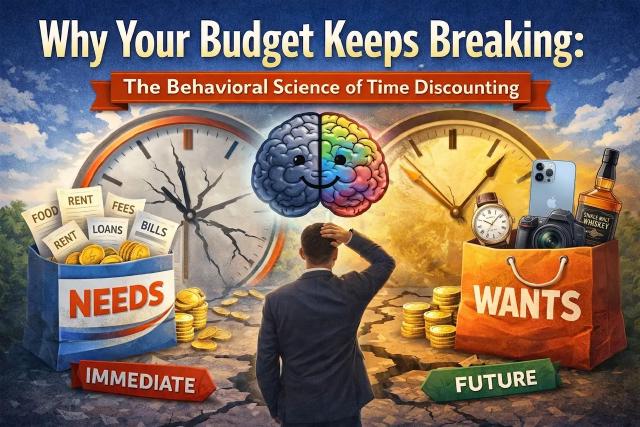
While financial plans break for a variety of reasons, one of the central behavioral mechanisms driving consistent budgeting failure is a cognitive bias known as time discounting.
This bias interacts with modern spending environments to quietly drain your accounts—and a structured framework for knowing when to rely on your habits, and when to escalate to an active system.
Is Budgeting Really the Problem?
Before fixing your habits, you need to answer a more basic question: is your budget actually the problem?
For most people, budgeting breaks for one of two very different reasons.
The first is structural. Your income is already spoken for. Rent, debt payments, and food take up almost everything you earn. By the second day of receiving your salary, there is barely anything left. There is no real “budget” to manage. A single unexpected expense is enough to throw everything off.
The second looks very different. You earn enough to cover your essentials, and there should be money left over, on paper. In practice, that extra money just vanishes in thin air. The problem is behavioural.
If you fall in the fast camp, where most of your income is locked into fixed costs, no budgeting method will solve it. The only meaningful levers are increasing income or reducing fixed obligations.
Sticking to the Rules Under Pressure
If you fall into the second category, the question is not whether you have a budget - it is whether you can follow it when conditions change.
- Have you ever set a strict spending limit, only to completely ignore it after a stressful day?
- Do you repeatedly override your own rules when checking out online?
- Do you stick to your budget when money is tight, but abandon it the moment a new paycheck arrives?
If these patterns repeat, your behavior is not stable. It shifts with context, fatigue, convenience, and perceived abundance.
That means your decisions are not being driven by your plan, but by your environment.
Why Your Brain Treats Future Bills as Optional
Every manual budget relies on one unspoken assumption: You will treat your future obligations as if they matter just as much as your present desires.
In environments with delayed consequences and low friction, this assumption conflicts with human psychology.
In behavioral economics, time preference refers to how much you value a reward today versus a reward in the future.
Hyperbolic discounting is the specific bias where our brains tend to favor immediate, short-term rewards over delayed, long-term payoffs.
Your brain simply does not evaluate:
- “I need $800 for rent due in 20 days”
- “I have $800 available in my checking account right now”
…as equal equations. The present is concrete and highly salient. The future is abstract. While other factors like emotional spending or social signaling play major roles, time discounting is a key mechanism that makes the initial decision to overspend feel harmless.
Modern Spending Environments Make Overspending Inevitable
Time discounting does not operate in a vacuum. It is a vulnerability that interacts dynamically with your environment.
1. Effortless Payments, Effortless Spending
You generally don’t blow a budget on a single catastrophic purchase; you blow it $15 at a time. In the moment, a $15 digital delivery feels negligible because the future impact is discounted.
Historically, the physical act of handing over cash created a “pain of paying” that acted as a natural brake. Today, digital wallets and one-click checkouts have removed this friction. Time discounting makes you want the immediate reward; frictionless payments ensure nothing slows you down long enough to reconsider.
2. Future You Is Doing All the Work (and Failing)
When you violate the budget today, you likely soothe the cognitive dissonance with a promise: “I’ll just spend less next week to make up for it.”
This adjustment often fails to materialize. Why? Because when “next week” arrives and becomes “today,” your brain applies the exact same discounting bias. You are frequently deferring financial responsibility to a future version of yourself who will supposedly possess endless discipline.
When Behavior Actually Works
Before we abandon discipline, it is critical to state that behavioral budgeting can work flawlessly. Manual tracking and willpower are highly viable, but only when your environment neutralizes the time discounting bias:
- Low-Friction Environments (e.g., Cash-only): The physical pain of parting with cash slows down impulse execution, countering the desire for an immediate reward.
- Short Feedback Loops (e.g., Daily tracking): Reviewing spending daily collapses the “abstract future” into the “concrete present,” making consequences salient.
- Stable Variables (e.g., Predictable routines): Highly stable routines reduce decision fatigue, leaving your willpower reserves intact to enforce your own rules.
If your financial life looks like this, your environment supports your behavior. You can successfully rely on manual spreadsheets and internal discipline.
Why Discipline Breaks (And How to Escalate)
However, if your environment is filled with variable income, high-stress days, and 1-click checkouts, the cognitive load becomes too heavy. When your behavior stops working, the solution is not to “try harder.”
The solution is to progressively escalate your environment design. You step up from systems that rely on your awareness, to systems that actively restrict your choices.
| Stage | When to Escalate to This | What Changes in Your Decision Environment | Enforcement Type |
|---|---|---|---|
| 1. Awareness | You can track consistently for 30 days without overriding your own rules. | Real-time Tracking: Log purchases manually at the point of sale. | Behavior-Supporting (Relies on willpower) |
| 2. Friction | You repeatedly override your mental rules when stressed or rushed. | Inject Friction: Delete saved cards; use physical cash envelopes. | Moderate Constraint (Slows the impulse) |
| 3. Automation | You actively skip or disable the friction you set up (e.g., pulling cash from the wrong envelope). | Automate Routing: Sweep money to savings on payday. | Behavior-Replacing (Removes the decision) |
| 4. Pre-commitment | You actively reverse constraints (e.g., manually transferring money out of savings to spend it). | Hard Fences: Move money into penalty-backed or time-locked accounts. | Strongest Constraint (Restricts agency) |
The 3-Step Budgeting Hierarchy
If your budget is currently broken, you should not immediately lock all your money away. Instead, follow a structured hierarchy of escalation. If you cannot maintain control at one level, move to the next.
Step 1: Try Behavior
Start with a passive system (Stage 1). Build a budget, track your spending manually, and rely on awareness. If you can maintain this without significant mental fatigue, stay here. You retain total financial autonomy.
Step 2: Reinforce Behavior
If Step 1 fails, inject friction (Stage 2). Implement the cash envelope system, delete your saved credit cards from online stores, and set up basic automatic transfers for your bills. You are still managing the system, but you have altered the environment to make bad decisions harder.
Step 3: Replace Behavior (The Case for Software)
If Step 2 fails—if you find yourself constantly “borrowing” from your grocery envelope to fund entertainment, or manually canceling your automatic transfers—your behavior cannot be relied upon in your current environment.
This is where purpose-built financial software becomes a logical escalation. Software manages Stages 3 and 4 by mechanizing the environment: it executes pre-commitments and enforces automation without requiring your daily input.
Understand the explicit tradeoff:
- DIY Systems (Steps 1 & 2): High flexibility, but high maintenance. They require constant decision-making.
- Software Systems (Step 3): Low maintenance, but low flexibility. They require you to surrender a degree of day-to-day autonomy for long-term consistency.
The Reversion Loop
Escalation is not always permanent. If you move to Step 3, but find the software constraints so rigid that you rebel, withdraw your funds, and abandon budgeting entirely—you have over-escalated. Drop back to Step 2. The goal is to find the strongest constraint you can consistently tolerate without abandoning the system.
If you have tried and failed at Steps 1 and 2, the goal is to get your biased brain out of the daily execution process. It is time to trade high-maintenance flexibility for a system that doesn’t get tired.